
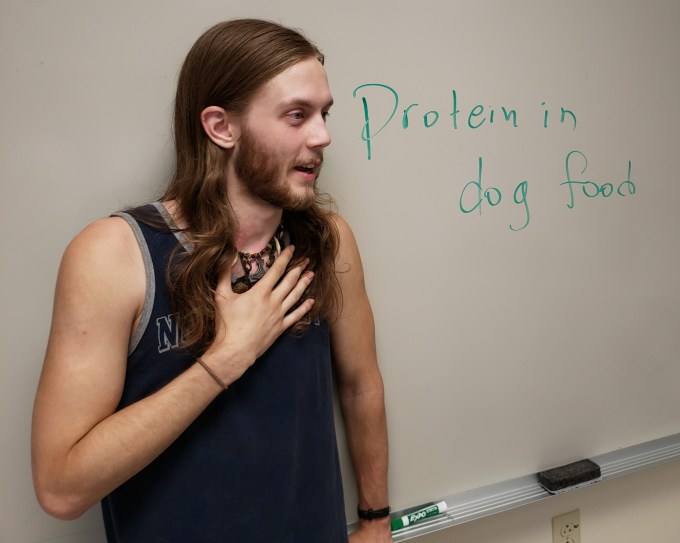
There is debate as to whether dogs are carnivores or omnivores. Some foods might be more appropriate than others for the digestive system of canines. Student Morgan Morris organized a biology laboratory interactive in which he gathered multiple brands of dog food for starch testing.
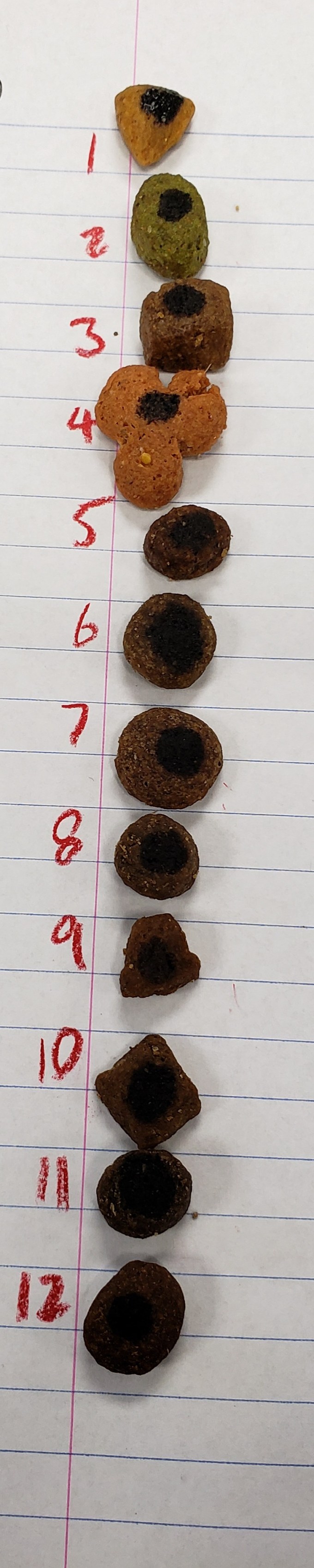
Note: This was not a laboratory-grade experiment but simply a survey of starch content utilizing potassium iodide as detection for starch in the dog food samples. We were looking for a range of black to lighter color gradations, which we believed were visual evidence of differing levels of starch in the dog food. The visual inspection was quite subjective with no established color scale for comparison utilized. We performed 6 different trials. It was a loosely controlled experiment; basically a simple inquiry.
Sample #5, and to an intermittent extent, samples #6, #9 and #12, illustrated a “browner” tint as compared to the jet black results on the other samples. Sample #5 had the most consistent color difference as compared to #6, #9 and #12. Approximately 5 out of 6 trials of sample #5 illustrated a markedly color difference from the jet black color of the other samples tested.
We concluded in this brief experiment, that sample #5, and possibly samples #6, #9 and #12 contained less starch. Student Jeff Collins proposed that the browner samples may have a higher fat content, thus potentially blocking the effectiveness of the iodine starch test. The brief discussion regarding the results were recorded in the video: “Starch in dog food | Student led inquiry.”
Your thoughts?
Recommended by Morgan:
https://www.dogfoodadvisor.com/
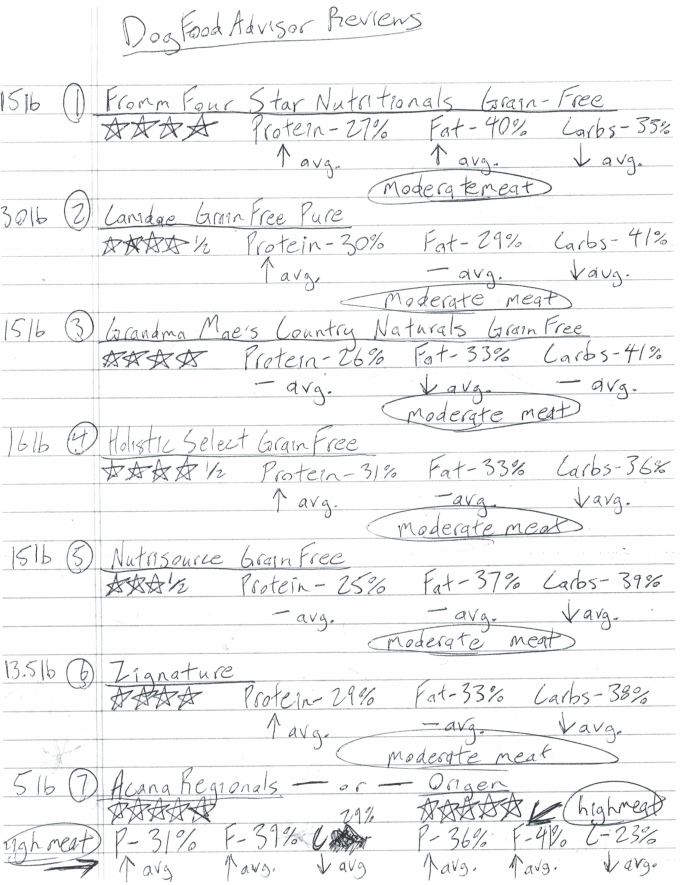
Note: The numbers in this list do not correlate with the numbers in the experiment we performed. They also do not indicate order of preference. They were just meant to showcase “likability” and nutritional aspects of the foods.
Added 9-26-2019
This information is solely for informational purposes. IT IS NOT INTENDED TO PROVIDE MEDICAL ADVICE. The author nor publisher take responsibility for any possible consequences from any treatment, procedure, exercise, dietary modification, action or application of medication which results from reading or following the information contained in this information. The publication of this information does not constitute the practice of medicine, and this information does not replace the advice of your physician or other health care provider. Before undertaking any course of treatment, the reader must seek the advice of their physician or other health care provider.
October 18, 2017 Barnes Disclaimer




 darrellbarnes.blog
Morgan , this is my question, should different breed of dogs eat different types of food?
LikeLike
Yes and no. Not specifically because of their breed, but more specifically because of their size, weight, age, and overall health.
LikeLike
Morgan, does the non obsorbing dog food mean it’s better for the dog? Or does it make it harder for the dog to digest?
LikeLike
What is #2 composed of to make it green in color? Does color have a direct correlation to the starch levels?
LikeLike
The green one is Pedigree, causes by artificial dyes, mainly just to make it look cute to a customer.
LikeLike
Do artificial dyes have negative health effects? Or does it not change anything health wise about the food?
LikeLike
Absolutely. Artificial dyes are exactly that. Artificial. They’re made with synthetic chemicals that are not naturally occurring so that it’ll be pleasing to the eye if the customer. It’s the same technique used in children’s breakfast cereal. But consider what affect those have on your dog’s digestive system.
LikeLike
This is very interesting that it compares to kids cereal,
because then you can kinda see what kids are really consuming.
LikeLike
Morgan, this is my question: how exactly did you propose that the browner samples have a higher fat content?
LikeLike
That was actually proposed by another student. But in short, iodine gets dark when added to starch. Fat isn’t as permeable to water, so in theory it wouldn’t absorb as much iodine.
LikeLike
I didn’t know dogs could eat vegetables, I always thought they only ate meat.
LikeLike
A good question would be, how different amounts of starch affect the dog?
LikeLike
The less the starch the better the food.
LikeLike
Morgan, what would happen if a dog were to go on a vegan diet?
LikeLike
Short answer, they’d die. Dogs need the taurine found in meat to survive. Vegan dog foods do exist, but they’re meant to have meats added to them afterwards by the pet owner. Dogs NEED meat, point blank.
LikeLike
Dang that was short and painless THEY WOULD DIE
LikeLike
What do you give your pets if anything
LikeLike
I use different foods that I get through my work. I’m currently using Canidae.
LikeLike
Are the dog treats all the same ? What about the color ?
LikeLike
What brand of dog food is #5? Is dog food like #5 with a higher fat content or one with more starch be healthier?
LikeLike
I think #5 was Iams
LikeLike
What do you do for a living? And what if any pets do you have?
LikeLike
I work at Hollywood Feed in Southaven, near wholesale nutrition. I have a shitzu and a German Shepherd.
LikeLike
All results seems the same to me so it makes it seem like no food is good for the dog
LikeLike
Yes and no. It really depends on specific ingredients.
LikeLike
Theoretically would wet dog food contain more, less, or about the same amount of starch as the dry brands tested above ?
LikeLike
It also depends on brands as well.
LikeLike
So what is the best type of food to feed a dog
LikeLike
Depends on your dog’s specific weight, age, size, and other conditions.
LikeLike
It really depends on your dog’s specific requirements.
LikeLike
How did you select the dog food, was it by the ingredients?
LikeLike
Really by what was available to me.
LikeLike
What Dog food do you prefer dogs to eat without a lot of starch in it? Also, what is one of the tremendous difference will it make in the dog for eating the starchless or almost starchless dog food?
LikeLike
Less starch means a healthier diet and good dog using its body’s fuel more than storing it, increasing muscle and decreasing fat.
LikeLike
I have the question as the other guy in the video, since #12 didn’t absorb the potassium iodide, does that make it harder for dogs to disgest the food or just make it a longer digestion duration?
LikeLike
What would happen if you injected into a plant ?
LikeLike
I don’t understand this comment. Please clarify.
LikeLike
Hi! Here’s my question, would you say dry or wet food is better for dogs in terms of starch? Also what made you want to conduct this experiment? Thanks 🙂
LikeLike
Wet food has more moisture, but starch content depends on the brand really. I used this as an expansion of a previous experiment.
LikeLike
Savannah, I agree. It would be helpful to know the best nutrition for our dogs. To your question I would add what does starch do to dogs specifically?
LikeLike
What type of conditioner do you use Morgan?
LikeLike
Agree, please tell us. My hair is so dry
LikeLike
We must know
LikeLike
perhaps a deep conditioning treatment
… maybe argon oil
Morgan, please tell us.
LikeLike
I wonder would there ever be any dog food made with completely no starch in the future.
LikeLike
Ketona is a very high protein low carb food.
LikeLike
I actually don’t. My hair has been dirty because of a very busy schedule. It usually looks much better. But it’s naturally healthy enough that I really only have to use water.
LikeLike
Would the smell of the food change the dogs behavior towards it.
LikeLike
In theory yes. Dogs have superb senses of smell, but not very good senses of taste. It really depends on the individual dog.
LikeLike
If I had to guess, yes.
But that does not change the fact that it is healthy or not for the dog.
LikeLike
Hey Morgan, how do you feel about me feeding my dog beggin’ strips ??
Are they actually a good source of protein?
Would feeding my dog straight bacon be better?
I usually just feed her what the media says to feed her… probably not the best idea¿
LikeLike
Beggin Strips are high in starch as well as artificial chemicals and preservatives like Glycerin, which is a sugar alcohol. While actual bacon would be healthier, typical store brands of bacon are high in sodium. Get uncured farm raised bacon that hasn’t been treated with hormones or antibiotics. But even that should be used sparingly.
LikeLike
will things change if you use a different type of food? what would happen if you used cat food???
LikeLike
My grandma puts garlic in the dogs food to help with ticks and stuff like that. We have a Golden Doodle and a Yorkie. If you give the dog to much garlic it could mess up their stomach badly which I think is weird because it takes them all day to eat it because it’s gross and smells bad. But we leave it out and eventually they will eat it because they will become hungry and they really have no other choice.
LikeLike
Please ask her not to give any more garlic to the dogs. Garlic is TOXIC to dogs. While some household foods can be safe and even healthy for dogs, that’s not always the case. High amounts of garlic can be deadly. Avoid it entirely. I would imagine that because fleas and ticks prey on blood, they they encounter the garlic in the dog’s blood stream and are thusly deterred. But you’ve only replaced one problem with another. I’d definitely say to get on a regular flea and tick preventative rather than a homemade remedy. My personally recommendation would be the Seresto Flea Collar that we sell for $57.99. Don’t let the price scare you. It lasts for 8 months, which is the biggest selling point, is water resistant, kills and REPELS fleas, ticks, mosquito, lice, biting flies, and their larvae, and starts working within 12 hours of use. It’s friction activated, so it needs to be fitted snug to the skin, like a wrist watch. After that, you can forget about it for 8 months. Going back to the price, while it is expensive upfront, when you consider the duration, you’re actually paying less money than you would for a topical or chew, but for better and longer lasting ingredients.
LikeLike
What do you think will happen if you change the dog food to cat food? Do you think the iodine will react differently?
LikeLike
I didn’t do the same test with dry cat food, one because it’s just yield similar results, and two, because I don’t think dry cat food should exist at all. Cats are different from dogs in that they can’t synthesize their own Taurine from meat the way dogs can. So they are even more carnivorous as a result. Canines are natural scavengers who compensate by pack hunting, whereas felines need a specific diet of high meat content, or they’ll die. Cats’ diets are naturally 90% meat. What’s worse, their bodies don’t urge them to seek water the way a dog will. A cat will get thirsty, but they won’t actively seek water to drink. This leaves them in a constant state of dehydration, which is also why cats are more attracted to loving water than standing water. If I were to test cat food at all, it’d be with wet food, which has more meat and moisture.
LikeLike
Good question! I was thinking the same thing. His answer was interesting too!
LikeLike
Morgan, this is my question: Is it bad if I let my dog eat straight corn starch?? Can starch hurt dogs? idk
LikeLike
Hopefully you don’t mean corn starch that we would use for cooking. Dogs have very versatile digestive systems and can eat all sorts of things, but that certainly doesn’t mean they should. The whole point, with both dogs and people alike, is the consume food that we’re not only meant to eat naturally, but to do so in it’s more raw and natural state. The second you start cooking something with heat, you break down it’s metabolic structure and basically digest it before it even hits the stomach. While this makes it easier to digest, you’re getting less nutrients. I’d highly suggest eating your fruits and vegetables in their raw state. Except for starches like potatoes. Potatoes can be toxic when undercooked, so is shy away from those. Starches should be kept at a minimum.
LikeLike
thanks morgan
LikeLike
My pleasure 🙂
LikeLike
would it be possible to do the same experiment on some of the treats that are given to dogs , like expensive treats vs inexpensive treats.
LikeLike
Question: are the dog treats the same brand? And does the consistency of the treats have anything to do with the color?
LikeLike
Are you asking about a specific kind of treat? A lot of brands of dog foods do have corresponding treats, but aren’t always made the exact same way. Origen and Acana, both made by Champion Pet Foods, do have a wide array of treats that are soft in texture and are mostly meat.
LikeLike
What’s the best brand of treats for dogs? Specifically a 5 year old silver Labrador. And is rawhide ok?
LikeLike
I think this is an interesting take to test for starch, but all the dog food seemed to receive the same results. The problem is the dog food is probably all proportionally close in starch to vegetable to meat content. Dogs are pretty adaptable to food and can really eat whatever as long as they have enough protein from meats.
LikeLike
True. Dogs are very versatile in what they eat. But that shouldn’t be taken for granted. Canines are evolved to eat meat, and lots of it. That’s their natural protein source. You could get away with feeding a dog more veggies than meat, and it would live, but would become unhealthy and eventually have medical issues like anemia, diabetes, and even organ failure. Such is the issue with many common brands of dog food.
LikeLike
Which one do you think would be the best brand of dog food that would be healthier for dogs
LikeLike
It really depends on your dog’s specific dietary requirements. There are certainly some brands that are all around healthier than others, but that doesn’t automatically mean they’d be right for your specific dog. You have to consider age, weight, chronic conditions, allergies, and breeding.
LikeLike
What type of dog are they feeding in the test?some may have different effect on the dog food
LikeLike
Origen, Country Naturals, Holistic Select, Natural Balance, Zignature, Fromm, Pedigree, Purina, Rachel Ray Nutrish, Iams and others
LikeLike
Hi Morgan! Could you let me know which number Purina was in this test?
I also would love to know what your take on grain-free food is? I have heard lots of people with dogs yak about how much better it is, but then through my research it seems that most vets would disagree. Curious to know your thoughts.
LikeLike
Wow this looked like a really cool experiment! What dog food brand had the most starch in it?
LikeLike
Pedigree
LikeLike
We did this test in lab yesterday; what a coincidence we’re seeing it again today. What brand had the least?
LikeLike
I would have asked the same question! Glad to know this information considering I feed this to my dogs!
LikeLike
Morgan, using the information that you gathered in your experiment, which dog food would be better for a dog ? One with a higher concentration or lower concentration of starch?
LikeLike
The lower the starch the better, hands down.
LikeLike
How much potassium iodide did you guys put on the dog food and what brand and u i agree with the numbers you guys said showed a browner tint
LikeLike
One or two drops per piece of kibble
LikeLike
So the reason why dogs are fat is because they are being feed dark food.
LikeLike
Canine obesity is mostly attributed to overfeeding. However a starch heavy food can certainly amplify this affect.
LikeLike
Morgan, this is my question were you Dr. Barnes shocked at the results after the experiment ?
LikeLike
Shcoked?! Just interested.
LikeLike
Personally I wasn’t, as I do this for a living. But it’s a shame that so many people feed low quality foods simply because they don’t know want better, and big box store brands will pass them off as something that they aren’t.
LikeLike
Well Morgan my question is so you think they will make dog food without any starch at all ?
LikeLike
While dogs are hyper carnivores, meaning that more than 70% of their natural diet is composed of meat, they are still omnivores in the fact that they have molars with which to consume vegetation. The argument can be made that the vegetation included in typical dog foods is there to replicate that which was eating by prey animals. So if a carnivorous wolf eats a herbivorous deer, there are getting nutrients from the plants the deer are as well. But specifically with starch, not many animals naturally eat high amounts of starch. The thing about carbs and starch is that they’re not necessarily bad, if you use them. But starch is an inefficient fuel source in that if you don’t use it, you lose it. There is actually a brand of dog food called Ketona that is 46% protein (very high) and has very minimal carbs.
LikeLike
That is really cool! Do you think you will ever do an experiment with wet dog food?
LikeLike
I could try with wet food but I wouldn’t know if it would yield the same results. Definitely something to consider.
LikeLike
Morgan, this is my question: Do you have a dog, and if so what kind of dog is it?
LikeLike
I have two dogs. I have have a 2 year old 85 pound German Shepherd, and a 9 year old 9 pound Shitzu.
LikeLike
What would happen if a dog started eating human food instead of dog food?
LikeLike
what type of dog food do you suggest?
LikeLike
Morgan what made you decide to test dog food? Was there a concern about what you were feeding your own dog if you have one?
LikeLike
I had no concerns. We originally did a small experiment using iodine to test for starch in crackers, and I pitched the idea to Dr. Barnes as a way of expanding the experiment as well as educated people not only about what their dogs eat, but their own food as well.
LikeLike
Did any of the dog food came out as the same result ? We’re more dogs omnivores than carnivores?
LikeLike
Do you think that lighter color food are healthier or darker?
LikeLike
Do you mean as they already are? Or as a result of the iodine test?
LikeLike
Yesterday, Morgan said that eating pumpkin is good for dogs.
LikeLike
Very true. Many orange veggies, especially pumpkin, have soluble and insolvable fibers that easily regulate dogs’ digestive systems. It can be used to treat bowel issues as well as regulating stool. Many foods are starting to include it.
LikeLike
I had not known orange vegetables could regulate the digestive system of dogs, very interesting!
LikeLike
Some foods did have similar results to others.
LikeLike
I think it poses the question that just because the dog food says it is healthy for the dog are all the added ingredients actually healthy for it
LikeLike
You’re exactly right. AAFCO, the entity that regulates dog food the way the FDA does for us, determines whether foods are “healthy” but title and ingredients aren’t the same. Their standards are often low and for a good to have a specific word suggesting that it’s healthy or natural or organic, they have minimal requirements to meet. Always read the ingredients.
LikeLike
People can treat their pets like family. I think this would be very interesting for those concerned with what they are putting into their beloved furry companions.
LikeLike
Very true. Many owners are shocked to learn that the foods they feed their family friends are actually detrimental to their health.
LikeLike
Sine you have experimented with dog food, will you now experiment with cat food?
LikeLike
I didn’t do the same test with dry cat food, one because it’s just yield similar results, and two, because I don’t think dry cat food should exist at all. Cats are different from dogs in that they can’t synthesize their own Taurine from meat the way dogs can. So they are even more carnivorous as a result. Canines are natural scavengers who compensate by pack hunting, whereas felines need a specific diet of high meat content, or they’ll die. Cats’ diets are naturally 90% meat. What’s worse, their bodies don’t urge them to seek water the way a dog will. A cat will get thirsty, but they won’t actively seek water to drink. This leaves them in a constant state of dehydration, which is also why cats are more attracted to loving water than standing water. If I were to test cat food at all, it’d be with wet food, which has more meat and moisture.
LikeLike
Could the browner tint be correlated to the color of the dog kibble itself?
LikeLike
Yes and no. The question is what specific ingredients make it that color.
LikeLike
I have the same question! I’m sure it was much easier to see while actually doing the experiment, but from the pictures I feel like the darkness correlates with the original color of the dog food.
LikeLike
Morgan, this is my question: What is the brand of dog food that was ultimately the “winner/loser?” Which brand is most commonly bought where you work? Thanks!
LikeLike
The most common brand that we sell is the big purple bag of Fromm Classic Adult. Fromm is a 5 generation family owned company, have been around for over 100 years, and it’s 33 pounds of food for $35.99. We also sell it to many different police departments.
LikeLike
I think It’s kind of cool that #12 did not soak up the iodide is just bubbled up on top. I also think it’s cool how most of the dog food turned a completely different color and some did not.
LikeLike
I agree. Number 12’s response was cool to observe even through pictures.
LikeLike
Much appreciated.
LikeLike
This is definitely an interesting experiment. It is shocking to me how many things I wouldn’t expect to have iodine in them but do. Great job guys.
LikeLike
The iodine is used to detect starch.
LikeLike
Lol starch***** not iodine 😂
LikeLike
I agreed. It is fansitcing what iodine can do in an experiment like this with dog food or cat food.
LikeLike
It’s not that iodine is in the dog food. We USED iodine to test for starches, as it turns black when making contact with a starch.
LikeLike
Interesting 🤔 what made u use dog food
LikeLike
We started out with crackers and I used dog food as an expansion of the original experiment.
LikeLike